Immigrant/Invasive
1. Nature
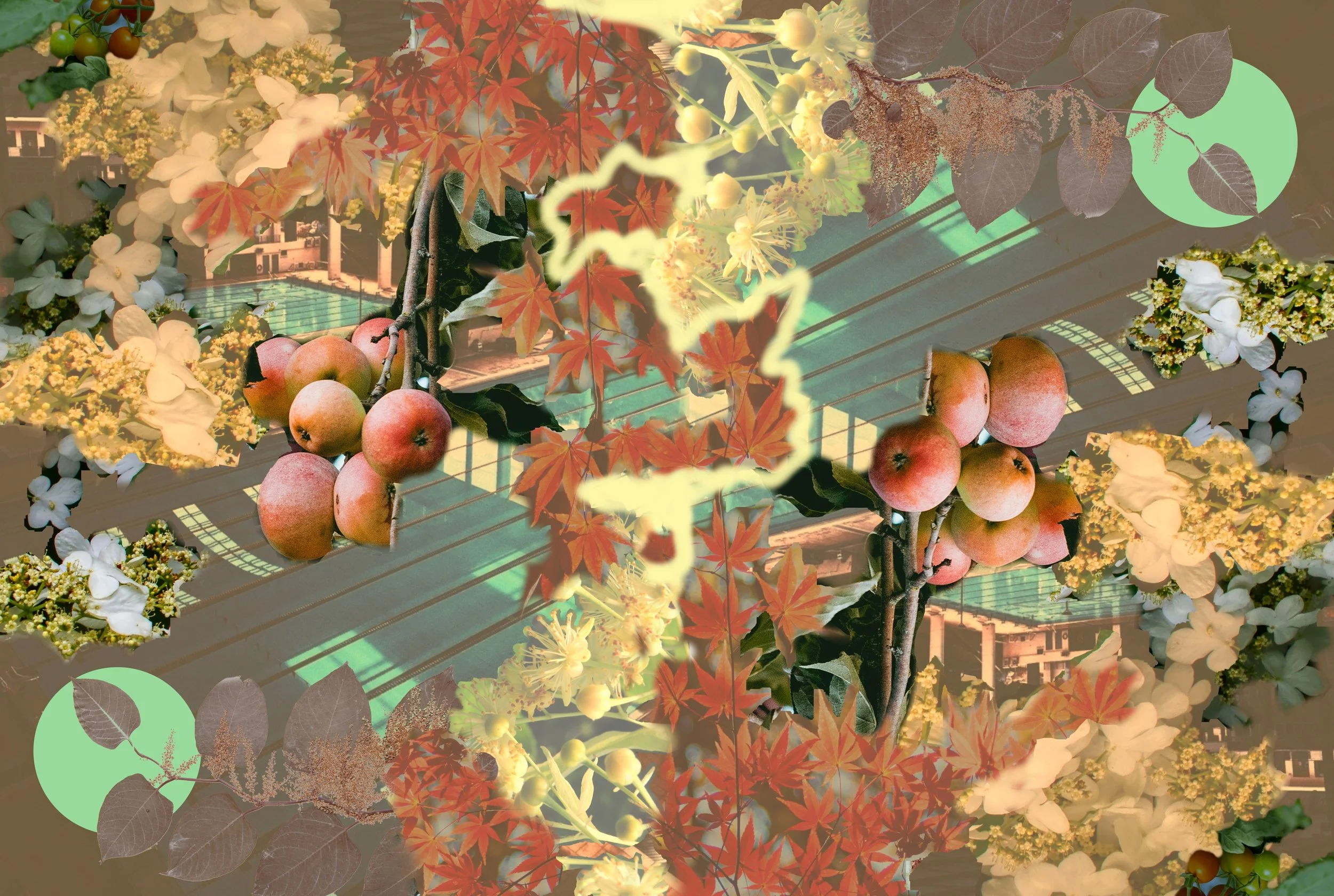
I tip my hat to the landscape architect of the Hilton Hotel at Logan Airport. Swimming laps in their glass-walled pool one autumn evening, I am enveloped in a lush understory of viburnum under a canopy of oak, maple, aspen and linden. It’s hard to remember I’m in the middle of a massive international airport.
Birds swoop by—crows, pigeons, jays and wrens, and a black-and-white one carrying off mouthfuls of berries to an upper-story window ledge. Squirrels dash up and down trunks. Mushrooms sprout under red oaks and golden-leafed apple trees.
This is not nature. It is an intersection of art and science. That landscape architect was clever enough to install communities of plant species – native and non-native – to create a natural “feel” for both human observers and a few feathered and furred inhabitants.
For the four-footed critters, cars serve as fenceline and alpha-predator: stray off-green and be squashed. For plants, the demarcation is less rigid. The Hilton’s tree canopy waves across the highway to the street-trees of Jeffries Point, whose roots sink deep into marshland that was filled in the late 19th century. Tree pollen easily flows across the intervening tarmac, as do insects and diseases.
As for migrating birds, if they can avoid hitting planes, the sky is the limit—no customs, no passport checks. The word “nature” has no meaning for them, as they cannot see a past or future, but only what surrounds them at any given moment. They are neither immigrants nor emigrants. They are home wherever there is wind beneath their wings and green branches to land on.
2. Knotweed
Yesterday, when a friend drove us from Vermont to the Boston airport, I seethed as unbroken miles of Japanese knotweed (Reynoutria japonica) rolled by. Knotweed lines our riverbanks, slipping along hedgerows, always reaching, seeds spreading on air currents, sprouting from any tiny piece of broken stem.
This plant is my nemesis. It devours my fiddleheading spots, decimates patches of native horsemint and sunchoke. Its dense wall blocks views of the river. Canoeing the river, it creates a claustrophobic, isolated stillness.
I hate this plant.
I know its spring shoots are edible. It makes a good chutney. Its September blooms provide late-season nectar to bees. But for me, it means no more muddy riverbanks tattooed with the tiny stories of mice, weasels, raccoons, fox. Just miles of knotweed.
My environmentalist buddies chide me for hating a plant.
You’ll be grateful for it when there’s nothing else to eat, one tells me.
If it keeps going, there won’t be anything else to eat, I reply.
What makes you think you know better than a plant, another says. Don’t judge through human eyes.
You wouldn’t say that about poison ivy growing up your kids’ swing set, I answer.
It’s like saying you hate immigrants, another says.
Not immigrant, I think. Invasive. It’s the difference between new Americans who own our local Dollar Store, and Spanish conquistadores who slaughtered millions of indigenous inhabitants in South America. Knotweed doesn’t slip peacefully into an ecological community. It obliterates.
3. Corn
I stand on the dirt-track driveway of the house my daughter is buying in Piemonte in northern Italy, looking across fields of corn stubble toward the Maritime Alps. My son-in-law patiently answers my question about the difference between i prati (meadows) and i campi (cultivated land).
What does it mean to be people of the corn in a place like this where corn – and tomatoes, eggplants, and potatoes – are foreign imports? Our dinner is tomato sauce with hot peppers over gnocchi and roast squash, a Native American meal with Italian seasoning.
That night I read about local yellow-and-red flint corn that looks exactly like Roy’s Calais Abenaki Flint Corn, a traditional Vermont variety I used to grow in my garden. I read about familiar autumn community corn-shucking parties, serving polenta with grape sauce.
I Google how long it takes before we consider something, or someone, indigenous. The phrase “indigenous people” is a new concept, say researchers from the University of Lapland, Finland (Sarivaara E, Maatta K and Uusiautti S. “Who is Indigenous? Definitions of Indigeneity,” European Scientific Journal Vol 1, 369-378 (2013)). Definitions are always context-bound, they write, before falling back on the definition developed at the International Labour Organization Convention no. 169 on Indigenous and Tribal Peoples in 1989: Peoples whose ancestors lived in the area before the formation of modern state borders.
If we think about plants the same way, Zea mays (corn) and the Solanum genus (potatoes, tomatoes, eggplants) landed in Italy three hundred years before Italian unification. When Italian troops conquered Rome in 1870, these crops had long constituted the core of Italian cultural cuisine. I crunch paste di meliga – cornmeal and lemon cookies – as I read, relishing how assimilation can create something greater than the sum of its parts.
Italians see corn and tomatoes as natives, as components of their self-identity. I’m the one viewing these plants as ex-pats, clinging to the construct that they “belong” somewhere else, in the place their ancestors came from, rather than in the very soil in which they are rooted.
4. Chestnuts
Turning my back on the cut-over cornfields, I walk through an iron gate, past the house and garage to the jewel of the property: the chestnut orchard. A couple acres of mature trees producing huge, sweet, single nuts prized for marron glace.
Among many reasons I am skeptical of the “first Thanksgiving” narrative, where Native Americans and Puritans supposedly came together to celebrate friendship with turkey and pumpkin pie, is that there is no mention of chestnuts. We are told that English colonists would have starved without indigenous friendship. But at that time, American chestnut trees were so thick a squirrel could travel from Maine to Florida leaping tree to tree. One would have to work hard to starve in proximity to chestnuts and the scores of other edible trees and plants on the New England coast. But Puritans were merchant class—perhaps they had no idea how to find food outside a market. In any event, American chestnuts were later annihilated by invasive chestnut blight.
I walk beneath straight lines of stately European chestnuts. Other than spikey fallen hulls, the ground is bare—a strategy to keep blight at bay and minimize chestnut weevils. I am suddenly keenly aware of the interface between my Vibram lug soles and this bare earth. I wore these hiking boots in the Vermont woods just days ago. Might they be carrying insect eggs and bacteria? Is my wool jacket the equivalent of a smallpox-infested blanket? The beauty of this orchard fills me with joy, but also trepidation bordering on stark fear: I am now responsible for these trees, and there is much I need to learn.
5. Garden
When I arrive back in Vermont, our rough-and-tumble garden is shutting down for winter. We practice “poor man’s permaculture”: weeding around the stuff that we, the bees and the birds eat. Our ragged yard holds equal portions of tender annual crops (tomatoes, peppers); stalwart perennial or self-seeding crops like walking onions, rhubarb and amaranth; and feral clumps of half-wild weeds like purslane, dandelion, yarrow, sheep sorrel, clover, and horse mint.
Chickadees cover dry stalks of mullein, pecking for the last seeds. Goldfinches mined these same flowers a few weeks ago before migrating thousands of miles south for winter. Some late yellow blossoms remain on the sunchokes—a Native American dietary staple. Yesterday I saw these sunchokes in an Italian market as a high-priced delicacy.
A neighbor, born in Korea, stops by and picks lambs’ quarters and garlic chives to make kimchi. A 93-year-old neighbor calls to ask if we still have chard and beets. We do, because I’d covered them to fend off frost before going to Italy. I’ll regret using timothy—the seeds of which some of my ancestors brought to Danvers, Massachusetts in the 1630s—because it will sprout in spring.
The summertime cacophony of bees, birds, squirrels, chipmunks and neighbors’ barbecues has fallen silent. Cabbage sits in crocks becoming sauerkraut like my Romanian great-grandmother made; tomatoes and applesauce are in jars the way my Irish canning-obsessed great-grandmother taught me; jalapenos and biquinos mashed with garlic fester in quart jars with salt bacterially metamorphosing into holiday-present hot sauce.
Like those birds at the Hilton Logan Airport, I see only the time and place that surrounds me—these green branches I land on. Here are people and plants and animals, some tracing their roots in this area back 10,000 years, many descended from ancestors who arrived a few hundred years ago, and a few who have just moved in. My home is a community that cannot be named with a categorical noun like “nature”. It needs a sweeping action word that continues moving through miles and generations: dialogue, intersection, engagement, migration. Change.
Nothing comes to a halt at this node of time and space I call home. As I write, knotweed is marching past my door, turning dialogue to silence and complexity to monocrop. Its threat to the community I love is not its foreign origin, but the effects of its actions here and now.
In the human world, locals are usually more lethal to their neighbors than immigrants. Undocumented immigrants are arrested at less than half the rate of U.S. Citizens, and violent crime rates by documented immigrants track well below those of citizens, according to the U.S. Department of Justice. It can be the same with plants, particularly once humans start tinkering. Maimed and twisted into a GMO row crop, my sacred, indigenous corn is doused with chemicals, polluting soil and water, turned into feed for methane-generating cows, and ethanol for gas-guzzling cars. I can’t save the seed from corn grown in my garden, as it is corrupted by GMO pollen. Corn has moved on; it is no longer in conversation with me. Yet tonight in Piemonte, someone is sitting down to a meal of a treasured organically grown heirloom-variety polenta.
In 1971, Barry Commoner penned his now-iconographic second law of ecology—everything must go somewhere—in reference to waste; when you wash your car in the driveway, soap runs into waterways. But in the nearly 55 years since I first read Commoner’s book, The Closing Circle: Nature Man and Technology, I’ve found a different meaning within them: It is the nature of nature to be in constant motion. As individuals, communities and species, we are all persistently changing and traveling. A necessary corollary to Commoner’s second law is that everything comes from somewhere, whether over the Bering Strait thousands of years ago, or from Mexico yesterday.
As Commoner’s first law more famously says: Everything is connected to everything else. “Nature” is, at heart, a description of how we all get along—how we all connect—when we find ourselves sharing the same moment of space and time. No living being should be judged on the basis of its place of origin, but rather on whether it is, here and now, a good neighbor.
Cindy Ellen Hill is author of a novel in sonnet verse, Leeds Point (Selkie Songs Publishing) and has penned four poetry collections. Read more.