(excerpted from Mobius: A Meditation on Art & Science, not yet published)
One morning as I was finishing a long meditation on art and science, I took a walk in the Anchorage Provincial Park. The trail leads through a boggy forest of black spruce, balsam fir, and yellow birch. The walk redounded with balsam scent, crow call, squirrel tsk, and the murmur of a lobster boat pulling a work raft back to Seal Cove harbour. I wasn’t looking for anything in particular. Just happy to get up from the desk and feel my limbs swing in salty air. I know the trail well. I have walked it frequently for the calm of forest and sea.
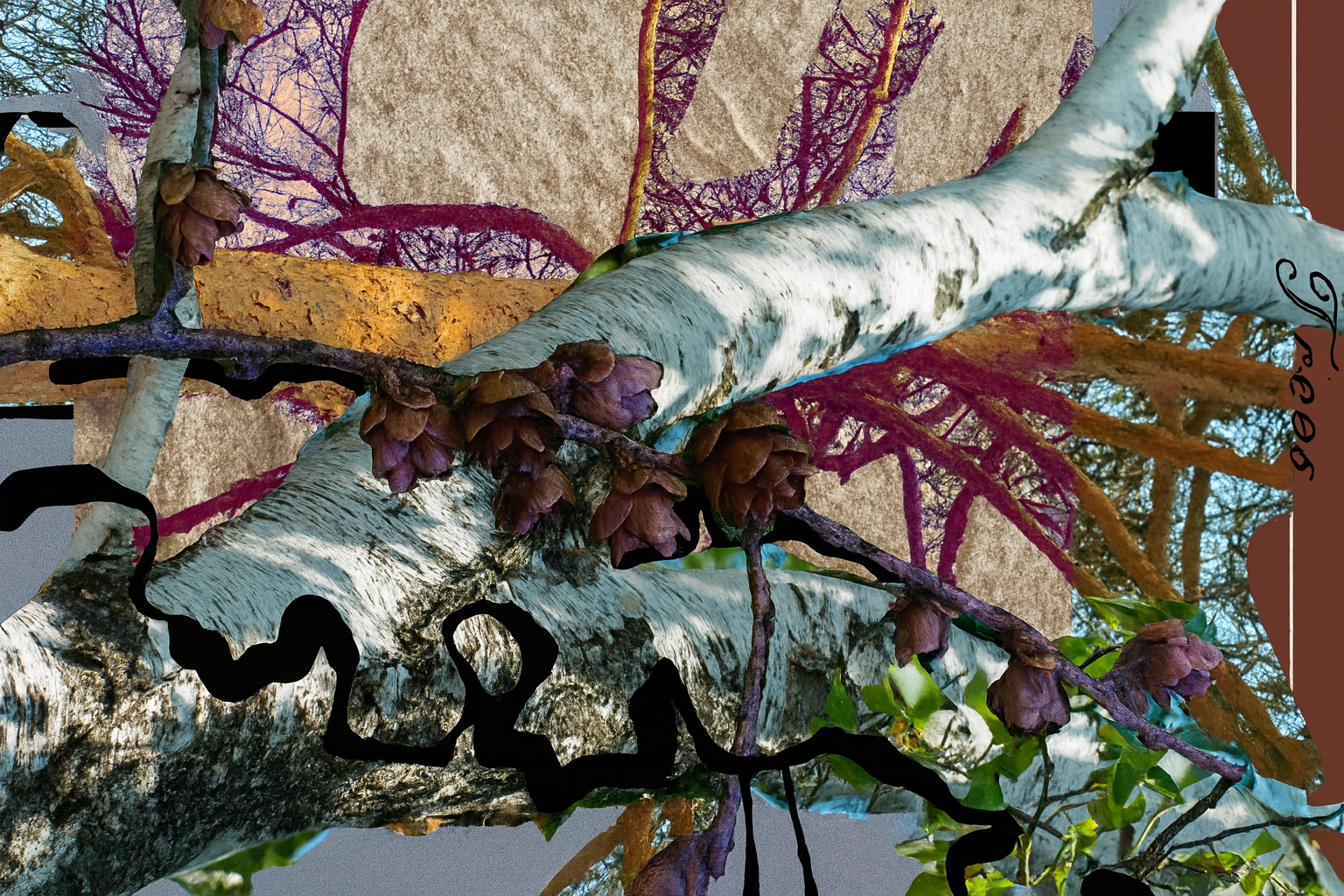
On this day a tree caught my eye, one I had never noticed before. It was a fused tree, one in which a balsam fir and a birch had grown together, not just side by side, but the birch’s flesh subsumed into the fir. On one side of the tree, the balsam has reached out as if to take a giant bite out of the birch, but the birch is perfectly happy with that, leaning slightly away then returning to its vertical climb. A small subsidiary birch trunk on the other side of the balsam grows right out of the fir’s fat trunk. Looks like some kind of fancy pastry with the soft folds of fir in doughy embrace of the smaller birch as it travels through the wood. From this confabulation at the tree’s base, both rise, equally strong and straight, both in an obvious state of flourishing as they reach through the canopy for the sun. It was an image that held me and seemed to announce its importance to me. I did not understand what I was seeing. It was powerful in its literal self. And it was powerful as metaphor. The sensory experience entered my inner life, where questions continued to swirl. What was it I wanted from art and science? How could they be seen as complementary and equally necessary to our humanity, when their differences were so apparent? I needed science to help me answer the question.
No, it was not a bite. More like a kiss. A deep kiss. Inosculation is the scientific term, which etymologically means “to kiss into.” Such a tree is known as a “marriage tree” or “love tree.” Fir and birch commonly grow together, I learned. Once I’d noticed the fused tree, I saw fir and birch pairings throughout this forest, many of them looking as if the two trees had grown out of a common root ball. None were as elaborately fused as the first pair I’d seen. Inosculation happens when branches, trunks, or roots rub together, abrading the bark to expose the cambium. The trees then lay down tissue that can grow vascular connections. After this natural grafting process, the connected tissues function as one, the birch tree passing nutrients—water, sugar, carbon—to the fir tree through the underground complex network of rhizomatic fungi. Birches are fast-growing; firs are slow-growing. The birch helps the fir’s growth and resistance to disease. And in the winter when the birch has lost its leaves the fir shares its nutrients. They appear as two separate and distinct trees, each with its own identity and methodology—leaves versus needles, deciduous versus conifer—and yet they exchange nutrients that help each of them better handle stresses.
So, I asked myself, what are the rhizomes that art and science share? These fields are as different as birch and fir. Art rising from experience and emotion. Science growing from hypotheses and data. Art is the slow-growing evergreen, holding its truth across centuries and millennia. Science, more like the deciduous tree, shedding old knowledge for emergence of the new. They will not fuse as one—though they were one in deep human history, before art, religion, and science branched out as ways of knowing. Their rhizomatic roots and early stages of growth are deeply entangled, lying in observation of the environment, a passion to know what it takes to survive and thrive, an appreciation of the mystery of life, an appetite for living on the edge of discovery, a sharing of knowledge that shapes culture and community and our humanity.
Alison Hawthorne Deming is author of six poetry collections and five nonfiction books. Read more.