Catherine Young
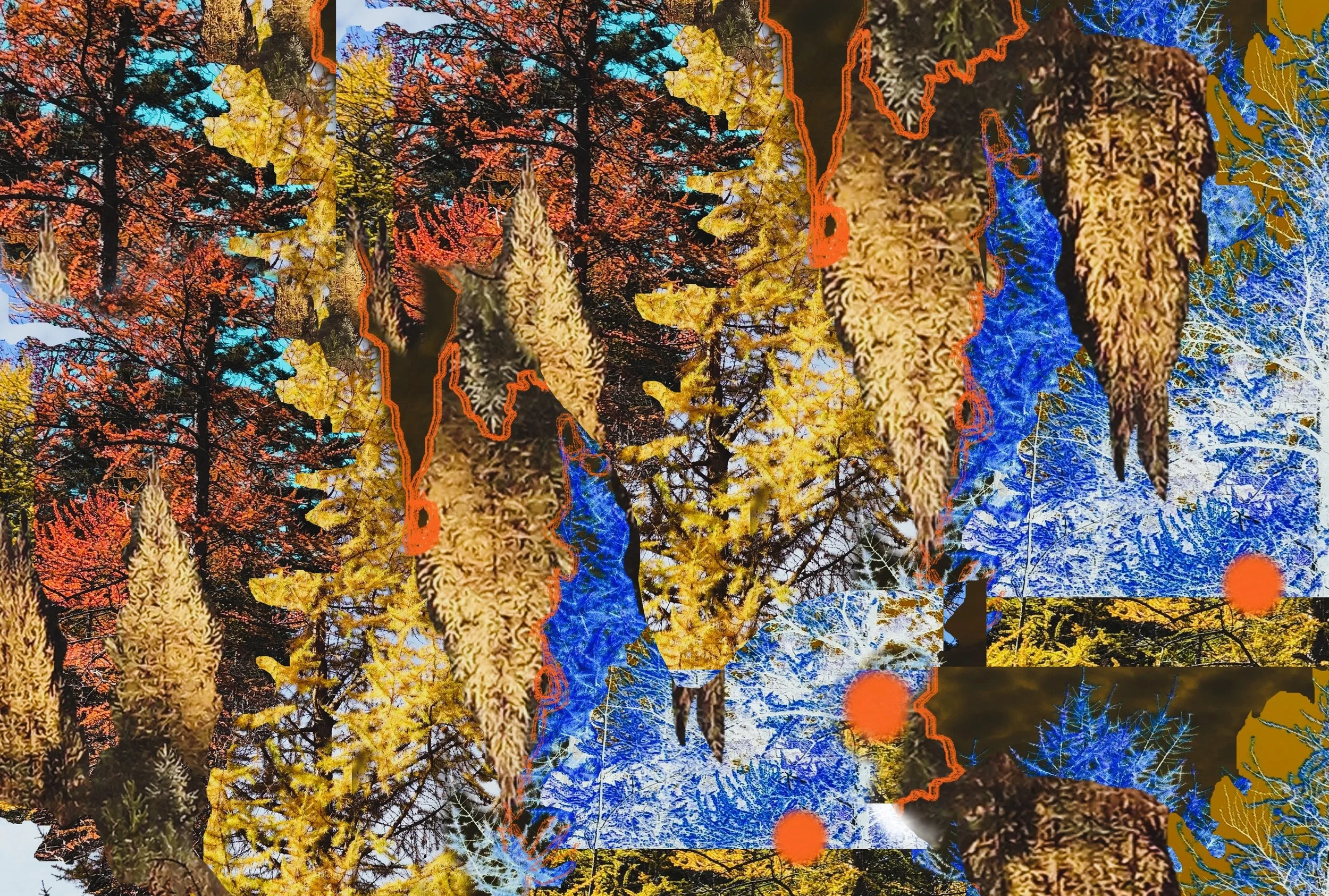
Remnant Tamaracks
Artist Statement: Talking & Listening to Plants
I live, farm, and write in the ecologically diverse Driftless bioregion in the Upper Mississippi River Valley. It is an island of unglaciated land— an island of holdouts: remnant pine trees from pre-glacial times, yellow birch and balsam fir trees far from their boreal relatives to the north at the Canadian border, the northern monkshood flower, and mollusks that grow nowhere else in the world.
I have always been in love with seeds and trees; I’m from a family of foragers in Appalachia. When I was a child all I wanted was to learn the name of each plant I saw and find out how to engage with it for food or medicine. I planted every seed that came my way. My university training was in plant ecology and fluvial geomorphology, and I worked as a National Park Ranger Naturalist helping others to engage with the natural world.
As a farmer, and as an artist, I am deeply rooted in place. I share my breath with the trees here, and in dwelling here and raising my food here for the past forty years, I am literally made of this place. I know my role in the soil and in the generations to come. I stand between the living present and the those who have passed to the stars.
One of my most thrilling roles was as Poet Laureate for a 1200-acre prairie where I could immerse in a restored bioregion, uplifting all the people, and the more-than-human beings past and present to ignite connection. The poem “Remnant Tamaracks” is part of that story.
Tamarack bogs preserve all kinds of stories, and because they are so inaccessible — that any step onto a bog does damage— we cannot easily go learn from these remnants. I am fascinated by seeing islands of bogs within a prairie so far south of boreal forest, long ago abandoned by glaciers. It is as if we are looking at the last Passenger Pigeon in a cage at a zoo. The American Tallgrass prairie is absolutely tied to human activity and requires fire and people interacting with it. But Tamarack bogs are quite the opposite. Isolated, they perhaps hold secrets for some future beings.
Catherine Young is a disabled writer and performing artist whose work is infused with a keen sense of place. She is author of the ecopoetry collection Geosmin (Midwest Book Award) and the environmental memoir Black Diamonds (Torrey House Press). Her work appears internationally and nationally in literary journals and anthologies. Catherine worked as an ecologist, farmer, and mother before devoting herself to her writing. She is Producer of the Landward podcast. Rooted in farm life, Catherine lives in Wisconsin. She deeply believes in the use of story and art as tools for transforming the world. More at: catherineyoungwriter.com