Love and Lichen
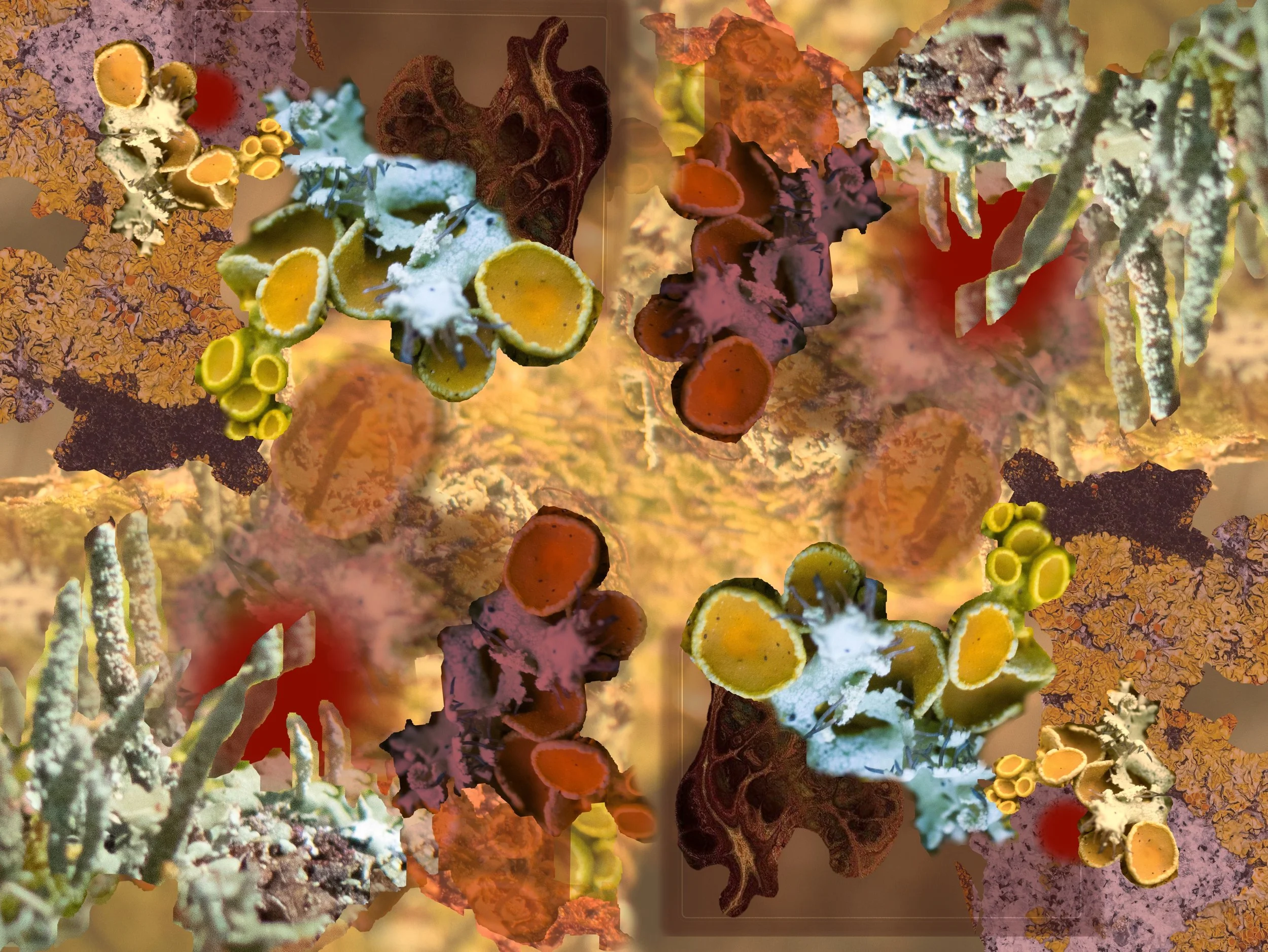
What sold us, other than the mountain greenery, was the wall of lichen near the north side of the house, covering 15 foot and higher boulders from an ice-age landslide. The gray Victorian ruffles softened the granite backdrop and spoke to us of things that last. While windthrow has knocked down whole neighborhoods of forest on our long, ascending driveway, while pipes have frozen, floors have warped and siding has rotted, the lichen clings to life on the ledge. A “pioneer species” (if it is a species), lichen moves in where nothing else will grow. And it’s all over the cemetery down in the valley, covering the names.
When I’m alone up here it’s easy to forget my human scale—what’s near, what’s far; what time it is, what year. On the one hand, most of the lichens are about the size of my palm, or maybe my face. But up close they look like aerial photographs or maps of empty continents, making me feel like a spore in the wind. The species is older than any plant, and some lichen can stay alive for centuries, though they don’t always look alive. My husband brings me back to our human here and now—a couple of aging baby boomers in the woods just off the Mass Pike.
I can’t help considering lichens in relation to our life. What’s wrong with seeing nature as a big outdoor mirror? Maybe we can learn a thing or two from the reflection. We can attach our insubstantial feelings to the physical world the way the lichens attach to substrates, without becoming parasites. For most people, lichen evokes the gloomy moods; it has the slight stench of the revenant about it. But I’m not the first to see lichen as a metaphor for love in later years. Love grows, the poets know, even in depleted soil. Like lichen, it was there in the dawn and will help life recover when we are gone. It attaches where disaster has struck, on toxic slag heaps and denuded war zones, in deserts artic and blazing. It has survived a journey to the moon and back, and some say it can take hold on Mars. Some say it doesn’t age; some say it is immortal. It can live on what cannot revive its youth and it lays the groundwork for a greener world.
The secret of lichen’s endurance is its deep entanglement. It maintains a rare kind of bond—two species united in “mutualism,” in ‘symbiosis,” coming together to form one living thing, a self-sufficient “we.” Fungus provides structure, and alga, photosynthesis. Some call it an organism, others say an ecology—maybe it’s both, like particle to wave. Either way, it’s a relationship that lasts.
Litmus derives from lichen, but there isn’t any test that can tell us how long we’ll last, or in what conditions. We’re still here with the lichen, more than forty years on; a lot of the greenery has pulled back. We’ve had our dry periods and our cool periods. Pieces have broken off, carried away by the wind. Sometimes we’re frustrated and restless, wanting what we don’t have, either mobility or roots. We bicker—he tends to dominate, cropping up from the underworld like the fungus’s visible thallus; I’m the algae, tangled in his cables, always the one reaching for sunlight, fighting the inertia. But at this point how well would we manage on our own? We’re like the lichen in that, at least—we’re not perennials; and we can’t go back to being what we were before we met.
Bonnie Costello is Professor of English Emerita at Boston University. She divides her time between Boston and the Berkshires, and between writing and hiking. Read more.