Tom Nutting
Bright Trouble
Artist Statement: Talking & Listening to Plants
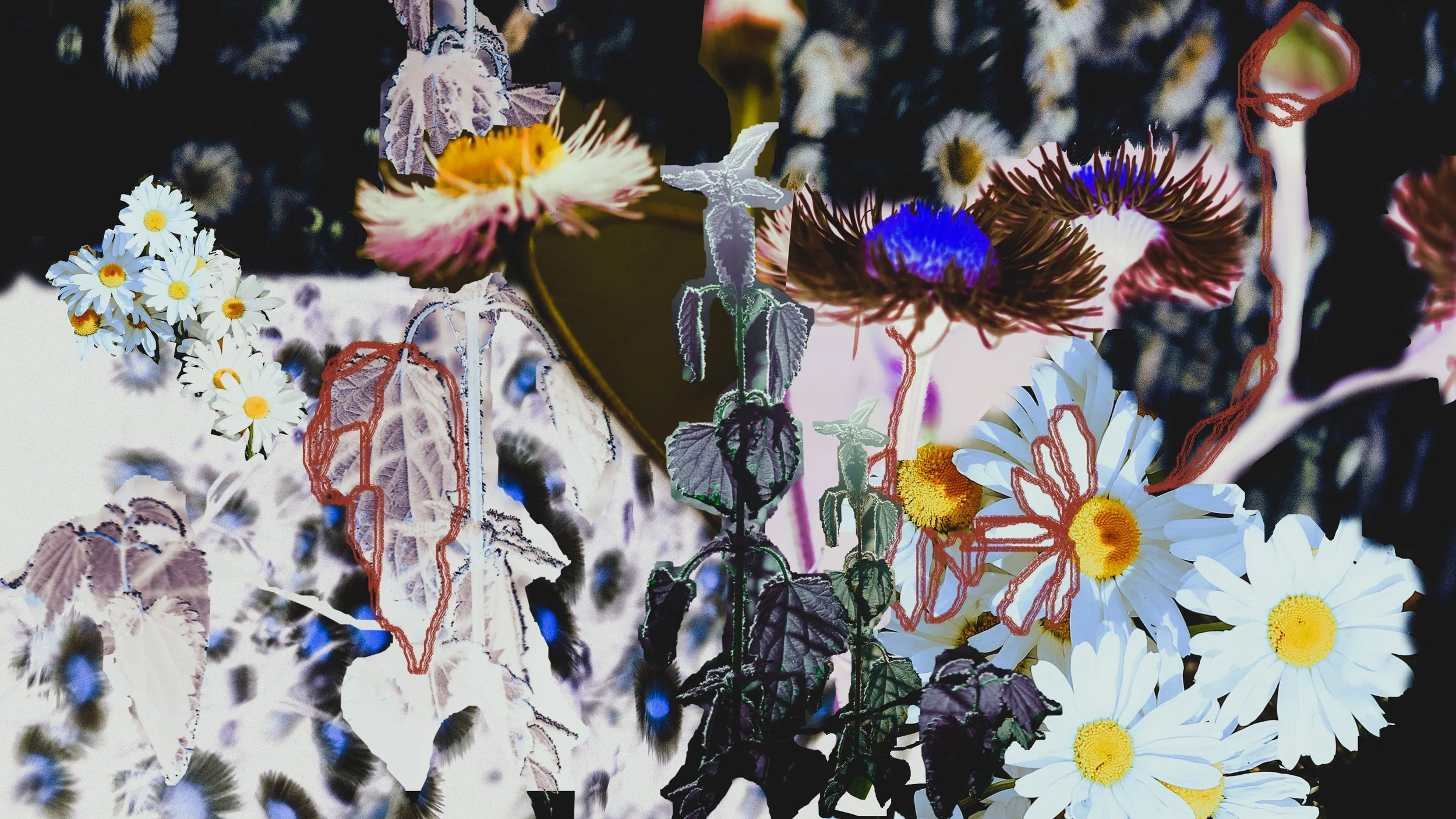
Before reading the article in the Guardian, January 2026 – “Winter blooming of hundreds of plants in UK ‘visible signal’ of climate breakdown’’ – quoted in the epigraph to my poem ‘Bright Trouble’, I'd noticed bizarre flowering that winter: daisies, dandelions and white dead-nettle blooming in January. It seemed obvious to me, as someone who lives with near-daily anxiety around the climate and ecological emergency, that this was connected to an unusually mild season. The article offered phrases that stayed with me — ‘winter blooming’, ‘visible signal’ — and raised questions about how we make sense of what we are witnessing.
The seed of the poem was the paradox of terrible beauty; these flowers were beautiful, perhaps made more so by their brightness against a particularly grey winter, yet that exuberance disclosed a climate beginning to exceed the seasonal rhythms by which we organize our lives — rhythms inherited through weather as well as histories of floral and pastoral poetry. Climate breakdown is often imagined — and experienced — as absence and loss, but here, briefly, it appeared as a strange abundance. I wanted to write into that doubleness, where beauty sharpens awareness of loss rather than softening it.
While writing the poem, I became suspicious of an impulse to diagnose the flowers. To describe them as ‘out of season’ is, in one sense, true, but it also risks repeating a familiar human desire to classify, regulate, and contain the more-than-human, a practice I wish to subscribe to less. What if these blooms are not simply signs of ‘disorder’ but invitations to think differently about ‘disorder' itself. My writing is often interested in illness, disability, and vulnerability, and in questioning the assumption that health — or flourishing — must always look orderly, predictable or timely. These questions also arise for me in my work as a psychiatrist and psychotherapist, as well as someone who lives with various diagnoses but, for now, says: I suffer, we suffer. ‘Bright Trouble’ asks whether suffering is a form of unruliness which can be both painful and frightening as well as alive and communicative.
In poetry, I’m interested in the botanical world less as a backdrop or storehouse of symbols than as a community of living beings with their own agencies, temporalities, and responses to environmental change. Although I remain fascinated by what flowers have represented across cultures, I am equally interested in what they are doing. In 'Bright Trouble’, the flowers refuse passivity: they flare, shout, spin, and dance. I wanted the language to follow their movement, amplifying momentum and voice to a world moving and speaking. The unsettling question is how we continue to carry on as though these flowers are not communicating.
I often begin a poem through a combination of close observation and unease: lingering with something beautiful that resists easy interpretation until it begins to reshape my thoughts and language, and hopefully the same and differently for people who read the poem later. ‘Bright Trouble’ cannot resolve the contradictions of ecological collapse, but I’d like to think it can ask what forms of attention — and perhaps what forms of joy — might remain possible within it.

Tom Nutting is a poet and editor based in Bristol, England. His writing explores themes of mental distress, nature and environmental mess, and queerness. He’s been shortlisted for the Starkie and MĀNOA poetry prizes and won the Lisa Thomas poetry prize. His poetry and prose have been featured in Magma, The Stinging Fly, fourteen poems, ORB, The Hopper, and more. He is an NHS psychiatrist and psychotherapist. He enjoys gardening and foraging.