Robert Lunday
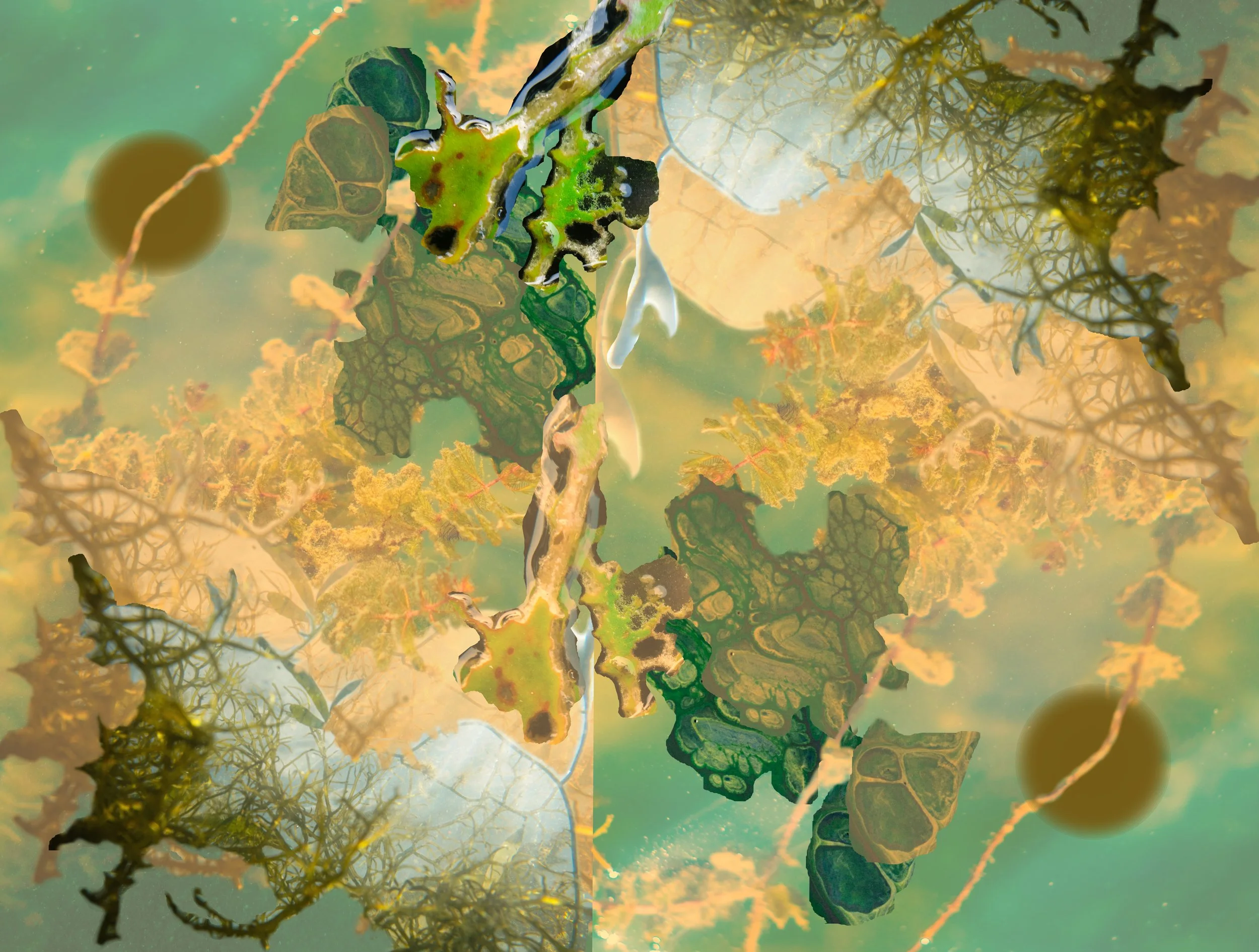
Algae
Artist Statement: Talking & Listening to Plants
Often I am permitted to return to a meadow
as if it were a given property of the mind
that certain bounds hold against chaos….
-Robert Duncan, “Often I am Permitted to Return to a Meadow”
Decades ago, barely out of college, I spent a summer on a Pennsylvania organic farm called Sonnewald. One of the people managing the farm, Grace Lefever, was an herbalist. Every night Grace led the young farm-apprentices to pick greens for our evening meal. The Lefevers grew dozens of different crops for sale in their store, but for our own evening meal we ate mostly wild weeds. Each night as we gathered our dinner from the field, Grace patiently pointed out one plant after another, naming it, detailing its medicinal and nutritional properties, describing its characteristics, its seasonal changes, sharing her own personal preferences and occasional stories of her life with wild plants. We picked what we needed each evening, then went back to prepare our giant salad.
I was not, at first, entirely happy with such a drastic change in my diet. My stools became green and I grumbled about what I missed from dining out in New York, where I’d been working and living a stressful life. But I realized fairly soon that I was getting healthier from the work, the fresh air, the relative ease of living, and those greens.
Before I returned at the end of the summer to my Manhattan life, I took a long look at that meadow. The simple, monotone, overgrown greenness I’d seen two months earlier was now a vivid, noisy, complexly detailed, history-rich space of information, lore, taste, and social connection. It felt like learning to read a musical score and suddenly realizing I could hear every line in a polyphonic composition.
As years went by, that Sonnewald meadow became a space inside me: my field of dreams, my private meadow. The valedictory vision of the field had become reciprocal: what I had seen seemed to look back at me, or at least was responsive to my looking, as if the rhythms of the summer – choosing and picking, learning names and qualities, washing, cutting, mixing, serving, eating, all together – were bound up in the vision of the field itself, and had grown into my way of seeing my ideal self in the world at large. Naming, in a sense, was a negotiation with everything present in the field.
That field is one of several primal scenes I possess after decades of writing. I would be hard-put to name the herbs in the actual field by now (I do my grazing at the grocery store), but as a poet, I am still wandering among the wilds – sometimes in real nature, sometimes in books or in my inner meadow – trying to put names to things, seeing how they feel, taste, and speak back to me.
Robert Lunday is the author of the memoir Disequilibria: Meditations on Missingness (University of New Mexico Press, 2023), Gnome, a lyric essay (Black Sun Lit, 2017), and Mad Flights, a collection of short poems (Ashland Poetry Press, 2002). Lunday lives with his wife, Yukiko, in rural Japan, with horses.