Donna J. Gelagotis Lee
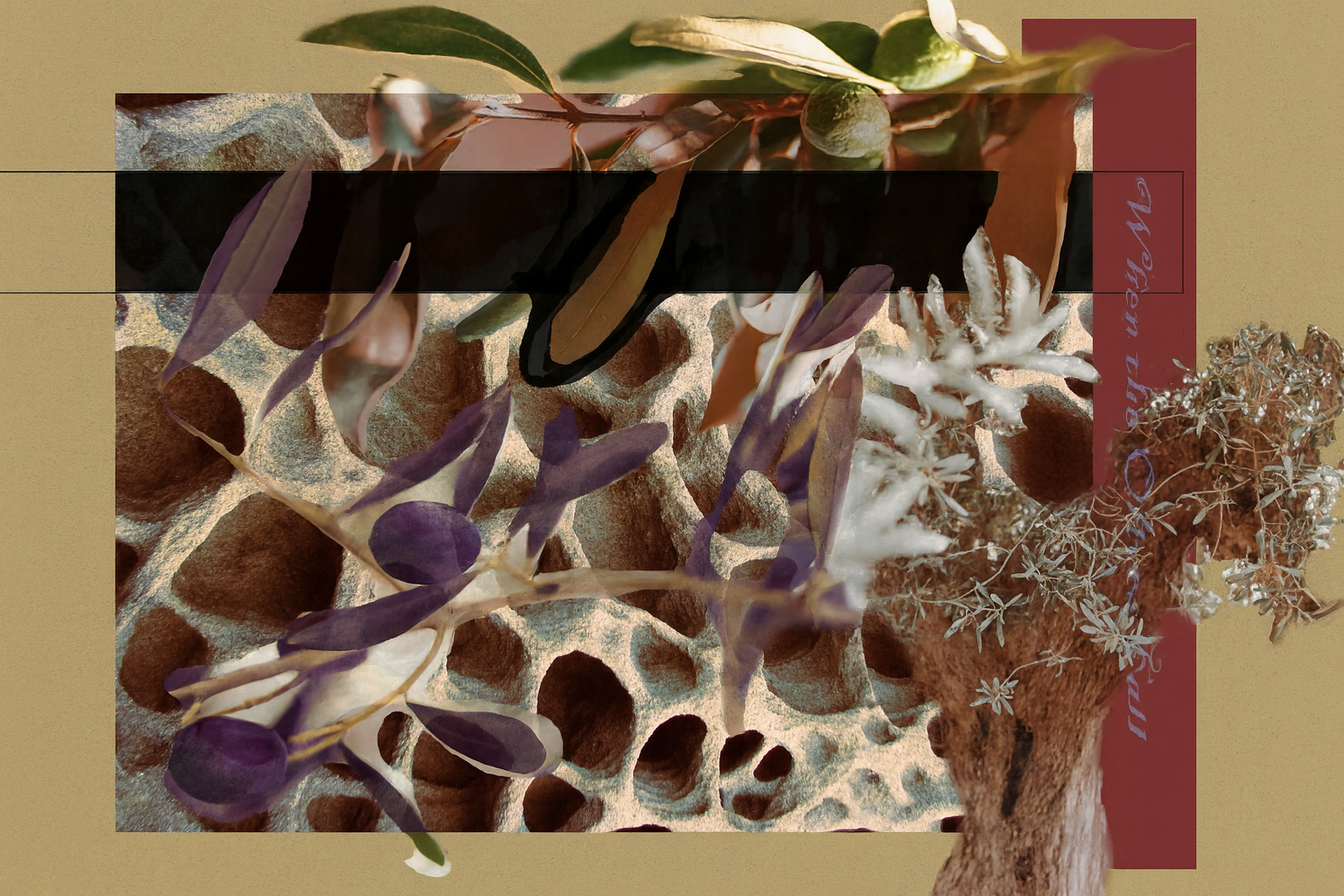
When the Olives Fall
Artist Statement: Talking & Listening to Plants
For about a decade, each year in early fall, I would stay in a home on a Greek island. This was the time of the year when the olive harvest would begin. The work was done by hand, usually by men and women of the island. It was a poetic scene from the point of view of the observer. But it was hard work for those engaged in it. Nevertheless, the labor spoke to something else, the tie of the land to its inhabitants, who not only worked on it but also prospered by its resources.
On Lésvos, miles of olive groves stretched over hillsides and climbed mountains. Olive trees anchored even on the beach. The olives’ taste, the distinct sound of the leaves when the breeze picked up, the olives’ scent, the trees’ thick trunks and gnarly branches, and their silvery leaves in moonlight enamored the senses. The olive trees were so much a part of Greek life that artists featured them in paintings, and villagers not only used and stored their oil for themselves but also sent it by ferry to relatives.
This poem was born of the memory of trips along the coast where I witnessed the people of the village harvesting olives. Olive trees endured even along the streets of Athens. On the island, the sight of the women kneeling among the nets and the men standing in the trees above with long sticks to knock down the olives was also a reminder of gender roles slow to change. Nonetheless, both men and women worked together in the harvest and joined to savor the results of their work.
Visually, olive trees reminded me of human figures, with their reaching limbs and sturdy trunks. On my walks along the streets of Greece, the trees punctuated rural, suburban, and city life with their sounds and scent. And their persistence, as they often thrived for hundreds of years, was tauntingly emulative. I can still sense how the olive trees stretched over the landscape and how their fruit brought people together in the harvest, through art, and through the food people shared, the scent of olive trees subtly lingering in the air.
When I think of olives in Greece, I can almost smell the olive trees during the harvest. I can almost taste the oil. I remember waking to the scent of sea and sun-drenched olive trees. I have walked along the island’s coastal road late at night with only the olive trees for company. It’s not surprising that the olive branch is a symbol of peace or that the trees can bring nourishment and comfort, sometimes joy. In my poetry, the olive trees have danced with one another. I, too, have performed a kind of dance with the olive trees.

Donna J. Gelagotis Lee is the author of two award-winning collections of poetry, Intersection on Neptune (The Poetry Press of Press Americana, 2019), winner of the Prize Americana for Poetry 2018, and On the Altar of Greece (Gival Press, 2006), winner of the 2005 Gival Press Poetry Award and recipient of a 2007 Eric Hoffer Book Award: Notable for Art Category. Her poetry has appeared in numerous anthologies and journals internationally, including Amsterdam Quarterly, Decomposition: An Anthology of Fungi-Inspired Poems (Lost Horse Press, 2010), Magma Poetry, The Massachusetts Review, and Terrain.org: A Journal of the Built & Natural Environments. www.donnajgelagotislee.com